Showing posts with label Liverpool Music. Show all posts

Tuesday, 20 March 2012

Thursday, 23 February 2012

The Singing City

Today, as following the themes of recent posts i'm going to look at music in the context of urban regeneration.

In 1965, during the midst of the great urban renewal where the Victorian slums of northern Liverpool were bulldozed wholesale the BBC sent a documentary crew to Liverpool.


The premise of this documentary was:

"How urban regeneration tore the heart out of the Singing City."


The documentary hosts interviews with dockers, priests, seamen and even the famous police constable 'Herbert Balmer'.   The highlight for me are the rare interviews with the women who kept the communities together when the men were away at sea. 

 For anyone who pines for the 'good old days' before they knocked the slum terraces down these interviews are a stark reminder of the utter deprivation, poverty and danger that haunted those terraces and tenements.

Listening to the stories of these people, it if difficult to believe that such poverty was still prevalent into the second half of the 20th Century.

This bleak image is constantly undercut by the use of music which is central to the film. Typical folksongs of the era are present in abundance (inclduing live recordings of Pete McGovern in local pubs) and even more remarkable is the recording of the childrens songs, sung on countless playgrounds.

These childrens playground songs and rhymes seem to echo through the ages but are held up to contrast with images of children in the same streets singing American blues music 'The Wood-chopping Blues'.  

This documentary really shows the birth of the modern world where children still have to sleep in houses infested by damp and rats yet the police were deploying CCTV in the city centre (30:00 mins).

Britains first CCTV cameras?  Liverpool 1965, showing the Metropolitan Cathedral half-built.

Was this the first use of CCTV in the UK?

You can watch the documentary here: http://www.bbc.co.uk/archive/mersey/5183.shtml

'There are no folk in the whole world so helpless and so wise, their is hunger in their bellies, and laughter in their eyes'.


Monday, 6 February 2012

Liverpool - An Altered Town


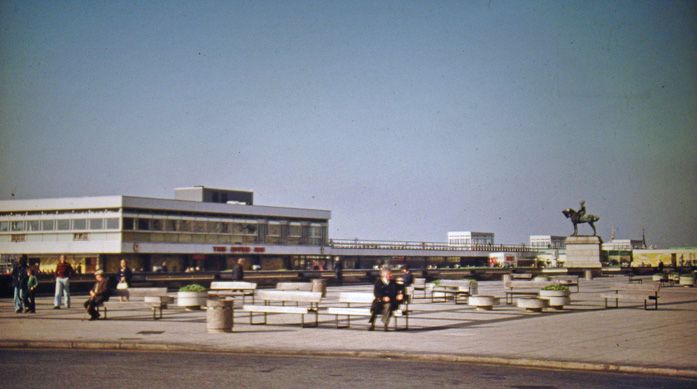
 One familiar with the city cannot help but look around Liverpool today and be astounded by the changes of the past decade.  The transformation of the city centre from the damp, drab and disintegrated (or perhaps disintegrating) concrete wasteland to the vibrant flowing modern city is a lesson in how to do town planning right!

However, you will always get people who yearn for yesterday.  People who think that the grass was always greener before (even if that grass was was the 1970s Pier Head *shudder*).

Regardless of whether these decisions have been seen out to be right or wrong, they have always acted as a catalyst for commemoration - often through the medium of folksong.

Liverpools latest transformation is just one of a series of massive changes that have altered the city - the first major change was the building of the Old Dock in the 1710s, without that we would not have Bold Street and the ropewalks area for they were built on the old wasteland heath over 'the pool' (below).

Map of location of the Old Pool on a mid-victorian town plan.

The Old Dock itself succumbed to the progress of commerce and civility and was filled in and by 1828 was the site of John Foster's magnificent Customs House (below).

This magnificent building stood until the actions of the Luftwaffe left it a burnt-out ruin, it was pulled down shortly after the war.

We look at it as a beautiful symbol of neoclassical grandeur at the hight of the Georgian period.
The people of Liverpool in the 1830s didn't necessarily see it that way.

This song; 'Liverpool's an Altered Town' seems astounding to us today but it really shows how the town changed between the 1700s and the 1800s.  It lists a number of churches that have been erected, how the old dock was filled in, how St Thomas's church spire was pulled down (neglecting to mention it was so high and jerry-built that it used to visibly sway in high winds!).

St Thomas's Church, before and after it's spire


What is even more fascinating is that this same tune was adapted to form a song that had the exact opposite sentiments, compare these two stanzas.

Liverpool is an Altered Town - 1830

"The spire of famed St Thomas's"      
"That long had stood the weather"
"Although it was so very high, they've downed it all together"
"And the Old Dock the poor Old Dock"
"The Theme of many a sonnet"
"They've pulled it up and now have built a customs house upon it"

Liverpool is Improving Daily - 1828

"Once Old Dock was so strangely fixt"
"The streets seemed not connecte'd"
"There ships and houses oddly mix'd, now a grand Customs House erected"
"What glorious sights on Kings Birthday"
"The ladies gay and music play"
"With all the Clubs so fine array'd, and Mr Mayor the first stone laid."

One song seems mired in misplaced nostalgia (the old dock the theme of sonnets?) and the other mired by jingoism and blatant civic boasting.

These songs, although in the folk tradition are not really folk songs.  The first one 'Liverpool is Improving Daily' was written in 1828 specifically for the grand procession to lay the foundation of the Customs House. It is basically a piece of spin, PR and propaganda.

The second song 'Liverpool is an Altered Town' was printed by John Harkness of Preston as a 'Broadside Ballad'.  These were printed in their hundreds, they were very popular and were often sold by pedlars and street-hawkers throughout the country.  There were not about collecting and preserving folk songs, but rather selling cheap-diversionary ephemera. 

 It is telling of where Mr Harkness's priorities lie that in his catalogue he also had ballad such as: "Preston is an Altered Town" and "Manchester is an Altered Town".


Friday, 6 January 2012

Wishing it was a Sunday - Seth Davy

The picture below is a fascinating thing for me.  At first glance it seems to be one of those Victorian street urchin pictures of Liverpool which seem to be ten-a-penny.  It was discovered by Matthew Edwards and posted on the 'Liverpool Folk Song a Week Blog'.


In it, a group of children gather around an old black man.  If you look closely you can see that the man is sitting with a thin plank of wood sticking out in front of him.  On the plank are three 'jig-dolls', dancing.

The year is sometime before 1902, the place is a long-since altered area of Liverpool known as Bevington Bush.  The cobbled streets and brick walls seem as far removed from a 'bush' as one can imagine, but for hundreds of years this was a small but well known hamlet of Liverpool.

So often these types of pictures are anonymous faces, but the old man with the dolls can be easily identified.  His name was Seth Davy and he has a remarkable musical legacy.

In the 1960s Glyn Hughes wrote a beautiful lilting tune called The Ballad of Seth Davy.

You can hear a lovely version of the song here:


The Dubliners, also did a version which replaced the 'Bevington Bush' with the area of Dublin 'Beggars Bush'. Such things often happen in folk music, which I think is great in showing the universality of the themes covered. 

On a personal note, my grandmother, a Scottie Road girl used to tell me about Seth Davy.  She didn't remember him but her father did.  He told her that as good as the Ballad was, it was wrong.  Seth Davy more likely drank whiskey all the week and buttermilk on a Sunday!

There may be some truth in this, Seth Davy used to sing the old minstrel songs from American south.  One of them, "Massa Am Old Stingey Man" includes the lyrics: - 

"Come day, go day,

I wish in my heart 'twas Monday;
I drink good whiskey all de week,
And butter-milk on Sunday."

Who was Seth Davy? A black street-artist who knew the old American minstrel songs?  He was a star of Liverpool in his day, known and photographed.  Yet we know nothing of him, West Indian, West African, Jamaican have all been proposed as origins.  Was he an escaped slave, fled 'cross the Atlantic?  History remains silent - as silent as his dolls are now.

Wednesday, 28 December 2011

Bob Dylan: Superstar in the Streets

In the 1960s a wave of British culture crashed upon the shores of the US.  All over America the sounds of British groups were blasting out of radios and a generation of US teens became swept up in the 'British Invasion'.  It was The Beatles that led the vanguard, but the trans-Atlantic traffic was not just one way.


Dylans 1966 Wolrd Tour would prove to be controversial, it was his first tour after his famous change from playing acoustic folk music to 'going electric'.  During this tour he made his second visit to Liverpool.

On 14th May1966 the bleak cobbled streets of north Liverpool became host to the 'coolest man in the world'.  In a bizarre moment the essence of swinging bohemian sixties style would meet the post-war poverty of Liverpool's urban youth.  He was due to perform that evening at the Liverpool Odeon, where he had first appeared a year previously.


Dylan and the photographer Barry Feinstein spent the afternoon before the gig wandering the austere post-war streets.  Feinstein  hated staged photoshoots and so when he stumbled upon a group of kids playing amongst the urban wasteland he realised had found the perfect photo opportunity.

Chris Hockenhall, a self-confessed 'Dylanologist', says:

 “Dylan and Feinstein just seemed to have stumbled into what amounted to a kids’ playground. It was such a clash of 1960s culture. The kids looked like Victorian street urchins and Dylan looked like a man from Mars with his loud shirt and wild hair – that’s what fascinated me.”


The streets in the photographs are eerily deserted of adults - no doubt because it was the day of the FA Cup Final, Everton vs. Sheffield Wednesday (Everton won 3-2).

It's interesting to note that the musical origins of Dylan and the Beatles seem to be exact opposites of each other.  The Beatles began as 'The Quarrymen' skiffle group, playing american folk music before moving into Rock and Roll whereas Dylan's development was the reverse.

Dylan's school yearbook claimed he: 'wanted to follow Little Richard' but by 1959 Dylan's tastes had changed.  He had given up the electric guitars and taken up banjos and harmonicas and he began digging deep into Woodie Guthrie and folk music.

Dylan seems to have a fondness for Liverpool, one wonders if this is born from his close links with the Beatles (he famously gave them their first joint!).  Only a few years ago whilst in the city Dylan took a history tour and was fascinated by John Lennons childhood bedroom in Mendips.

Perhaps though, Dylan's links with Liverpool are earlier.  A year before he met the Fab Four, Dylan wrote and recorded a song called 'Farewell' (sometimes 'Fare Thee Well').

It's tune and words are taken from 'The Leaving of Liverpool' -  a traditional folk song, well known amongst Liverpool households from the 1880 onwards.

Chris Hockenhull tracked all ten of the children down, all now grown and in their fourties, and recreated the photograph.  Amazingly non of the children remember meeting the bohemian bard.  Their grubby playground of cobblestones and bomb-shattered wastelands were a thousand miles away from the glitz of the swinging sixties.

Yet I wonder, when Dylan stood with those children on the steps of a warehouse in 1966, did he realise that most of them would've probably known the tune - if not the words to his earlier recording?

Images courtesy of


Thursday, 15 December 2011

Hello -

Hello and welcome to my new blog where I hope to be exploring the rich musical heritage of the City of Liverpool, England.


Now, you probably know about The Beatles - and you can't really talk about Liverpool music without mentioning them - but I want the scope of this blog to go beyond Merseybeat.

The name of the blog, 'Beneath the Beat' isn't just a nod to the fab four. It's a statement saying that beneath all music are the people who make it and listen to it.  I want to focus on the music that came from everyday people - from the basements of pubs right up to the terraces of Anfield and Goodison Park.

 It's an acknowledgement that for every Merseybeat there were other musical threads continuing through Liverpools history, not as popular but every bit as important.  From the sea-shanties and folk tunes of the quaysides to the DIY punk of Eric's and the current resurgence in live jazz music in pubs and bars across the city.

I hope that over the coming months, you will find something here to interest you.

If you have any ideas or comments about what you'd like to see on here, please get in touch. It'd be great to hear from you.