Sunday, 18 March 2012

The Beat of the Street

This blog aims to be about the more obscure, uncelebrated and forgotten music history of Liverpool.

There is no aspect of music history more forgotten and uncelebrated than the art of busking.  It's one of the oldest types of performance, from the moment a cave man first picked up a bone-flute there was probably a crowd around him throwing brightly coloured stones at his feet.

The sheer amount and quality of buskers in Liverpool at the moment is staggering, from the top of Bold Street to bottom of Lord Street - less than a mile there were about 10 of them.

A musical mile. 17th March 2012. Liverpool


It is claimed by the council that this is too many.  There are plans afoot to start charging buskers for one of 25 slots in the city centre.  Charges should be around £20 per anum.  Is this needed regulation, or simply a cynical money spinner for the cash-strapped council?

My worry is that with only a limited number of pitches there will be very tight competition and newer artists may never get the permit to perform.

Some of the proposed busking spots?  Are there enough?

They've always lived in a strange nether-world between professional and amateur, some buskers make a living through selling high-quality CDs from the pavement, others are barely able to hold a guitar.  Buskers in all their varied mixes give a colour and depth to a street that would otherwise be missing.  Let's hope this charging scheme doesn't affect it too much.

Thank god they're still here!

Thursday, 8 March 2012

Clean Bandit

This blog is primarily about music history, the last few posts have been deep into that history. 

As i'm firmly of the opinion that history is merely what's happened today viewed from tomorrow I thought i'd show you that i'm not just stuck in the past.


Let me give you a brief heads up on a band with Liverpool connections that I think deserve a promo.

Clean Bandit, are an up-and-coming London based electro-classical ensemble. 

Yep, you heard, Electro-Classical, smooth electro beats based around a string quartet core.  It's not just a novelty, the band are drenched in classical music knowledge - just check out their single 'Mozart's House'.


Their main man and drummer are from just over the water.  Birkenhead born Jack ("Wandeck") and Luke Patterson are part of the driving force behind the most refreshing sounds i've heard for a while.  

Their latest single, UK Shanty, could be equally set in the coves of Cornwall or on the expansive Seaforth foreshore where seagulls dodge Gormleys in watercolour sunrises.


If the success of their first musical forays are anything to go by, they'll soon be finding their path etched into the flagstones of musical history and perhaps become another band irrepressibly linked to Liverpools dynamic music scene.


Thursday, 1 March 2012

Skipping a Beat 1 - Mysterious Ladies and Curly Haired Sailors

Whilst viewing many old black and white documentaries about Liverpool it struck me how often the images were of children playing in the streets, accompanied by songs.


 Skipping games seem to have their own traditional music and tunes.


From one generation to the next, skipping and playground songs seem to sustain themselves.    I imagine if photographers and film-makers were allowed they would find that similar songs are being sung at skipping games nowadays as were being sung 100 years ago.


As a type of tradition music it's overlooked but when analysed gives us a window into class, religion and the concerns and worries of peoples every day lives.


It's widely believed that 'Ring o'Roses' is a song about plague and disease, whilst 'I like an apple and I like a pear' is really a song about the hardships of marriage to a unsuitable husband.


O I like an apple and I like a pear
And I like a sailor with nice curly hair
O gee I love 'im, I can't deny it
I'll be with him wherever he goes


He stands on the corner and whistles me out
He shouts Oo-ey, oo-ey, are you coming out? 
O gee I love 'im, I can't deny it
I'll be with him wherever he goes

He bought me a shawl of red, white and blue 
And when we got married he tore it in two 
O gee I love 'im, I can't deny it
I'll be with him wherever he goes


Many women dreamed of a marriage to a nice sailor!

There are more sinister versions of this song, probably not sung by children but no doubt well known:

Before I got married I wore a black shawl
But now that I'm married I wear bugger-all
Still, I love him, can't deny him
I will be with him where ever he goes

Before I got married I'd sport and I'd play
But now, how the cradle stands in my way
Still, I love him, can't deny him
I will be with him where ever he goes


Another one has a casual mixture of contemporary references and ethnic identity.

Micky mouse is dead

He died last night in bed

He cut his throat
With a ten pound note
And this is what he said
Red white and blue
Me mother was a jew
Me father was an Irishman
And out goe's you

There are a certain number of set tunes or variations of tunes that seem well known right across the world.  It would be impossible for us to tell where songs originally came from but we can assume that the hundreds of children that passed through the 'Gateway of Empire' that was Liverpool brought their own traditions and songs with them.


These songs are not specific to Liverpool, but they were very common here especially songs involving handsome sailors and beautiful maidens. 


Sometimes life was better in the old songs...


 It is telling that in a port city where men would often be absent for weeks on end and women were left to fend for themselves and their families the romantic ideal of a nice sailor coming home with the bounty of the world for his girl would have a strong resonance.


It's no surprise that the innocent girls who sang these songs would later become the tough and hardy matriarchs that seemed to rule Liverpools streets and alleys with iron fists.


Do you have any songs that you remember from childhood? 


Thursday, 23 February 2012

The Singing City

Today, as following the themes of recent posts i'm going to look at music in the context of urban regeneration.

In 1965, during the midst of the great urban renewal where the Victorian slums of northern Liverpool were bulldozed wholesale the BBC sent a documentary crew to Liverpool.


The premise of this documentary was:

"How urban regeneration tore the heart out of the Singing City."


The documentary hosts interviews with dockers, priests, seamen and even the famous police constable 'Herbert Balmer'.   The highlight for me are the rare interviews with the women who kept the communities together when the men were away at sea. 

 For anyone who pines for the 'good old days' before they knocked the slum terraces down these interviews are a stark reminder of the utter deprivation, poverty and danger that haunted those terraces and tenements.

Listening to the stories of these people, it if difficult to believe that such poverty was still prevalent into the second half of the 20th Century.

This bleak image is constantly undercut by the use of music which is central to the film. Typical folksongs of the era are present in abundance (inclduing live recordings of Pete McGovern in local pubs) and even more remarkable is the recording of the childrens songs, sung on countless playgrounds.

These childrens playground songs and rhymes seem to echo through the ages but are held up to contrast with images of children in the same streets singing American blues music 'The Wood-chopping Blues'.  

This documentary really shows the birth of the modern world where children still have to sleep in houses infested by damp and rats yet the police were deploying CCTV in the city centre (30:00 mins).

Britains first CCTV cameras?  Liverpool 1965, showing the Metropolitan Cathedral half-built.

Was this the first use of CCTV in the UK?

You can watch the documentary here: http://www.bbc.co.uk/archive/mersey/5183.shtml

'There are no folk in the whole world so helpless and so wise, their is hunger in their bellies, and laughter in their eyes'.


Monday, 6 February 2012

Liverpool - An Altered Town


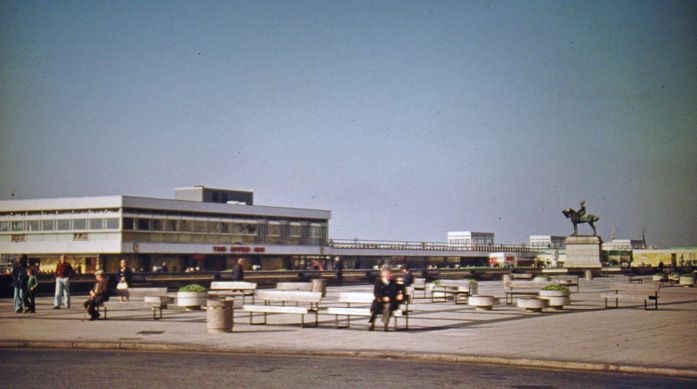
 One familiar with the city cannot help but look around Liverpool today and be astounded by the changes of the past decade.  The transformation of the city centre from the damp, drab and disintegrated (or perhaps disintegrating) concrete wasteland to the vibrant flowing modern city is a lesson in how to do town planning right!

However, you will always get people who yearn for yesterday.  People who think that the grass was always greener before (even if that grass was was the 1970s Pier Head *shudder*).

Regardless of whether these decisions have been seen out to be right or wrong, they have always acted as a catalyst for commemoration - often through the medium of folksong.

Liverpools latest transformation is just one of a series of massive changes that have altered the city - the first major change was the building of the Old Dock in the 1710s, without that we would not have Bold Street and the ropewalks area for they were built on the old wasteland heath over 'the pool' (below).

Map of location of the Old Pool on a mid-victorian town plan.

The Old Dock itself succumbed to the progress of commerce and civility and was filled in and by 1828 was the site of John Foster's magnificent Customs House (below).

This magnificent building stood until the actions of the Luftwaffe left it a burnt-out ruin, it was pulled down shortly after the war.

We look at it as a beautiful symbol of neoclassical grandeur at the hight of the Georgian period.
The people of Liverpool in the 1830s didn't necessarily see it that way.

This song; 'Liverpool's an Altered Town' seems astounding to us today but it really shows how the town changed between the 1700s and the 1800s.  It lists a number of churches that have been erected, how the old dock was filled in, how St Thomas's church spire was pulled down (neglecting to mention it was so high and jerry-built that it used to visibly sway in high winds!).

St Thomas's Church, before and after it's spire


What is even more fascinating is that this same tune was adapted to form a song that had the exact opposite sentiments, compare these two stanzas.

Liverpool is an Altered Town - 1830

"The spire of famed St Thomas's"      
"That long had stood the weather"
"Although it was so very high, they've downed it all together"
"And the Old Dock the poor Old Dock"
"The Theme of many a sonnet"
"They've pulled it up and now have built a customs house upon it"

Liverpool is Improving Daily - 1828

"Once Old Dock was so strangely fixt"
"The streets seemed not connecte'd"
"There ships and houses oddly mix'd, now a grand Customs House erected"
"What glorious sights on Kings Birthday"
"The ladies gay and music play"
"With all the Clubs so fine array'd, and Mr Mayor the first stone laid."

One song seems mired in misplaced nostalgia (the old dock the theme of sonnets?) and the other mired by jingoism and blatant civic boasting.

These songs, although in the folk tradition are not really folk songs.  The first one 'Liverpool is Improving Daily' was written in 1828 specifically for the grand procession to lay the foundation of the Customs House. It is basically a piece of spin, PR and propaganda.

The second song 'Liverpool is an Altered Town' was printed by John Harkness of Preston as a 'Broadside Ballad'.  These were printed in their hundreds, they were very popular and were often sold by pedlars and street-hawkers throughout the country.  There were not about collecting and preserving folk songs, but rather selling cheap-diversionary ephemera. 

 It is telling of where Mr Harkness's priorities lie that in his catalogue he also had ballad such as: "Preston is an Altered Town" and "Manchester is an Altered Town".


Thursday, 19 January 2012

Dirty Old Towns

Following my last post numerous people have asked where 'Bevington Bush' was. 


 It was located on the west side of Scotland Road, just north of Leeds Street.  The area has changed massively. All the crowded slums and  enormous brick warehouses were swept away in the 1960s  to create the rather bland mish-mash of 1970s council houses and perimeter fenced private developments.


When a city undergoes great changes it is often a catalyst for the creation of songs that reflect that change.  In my last post I posted 'Beggars Bush' replaced 'Bevington Bush' when the song was sung in Ireland, moving the area from Liverpool to Dublin.  A similar thing has happened with the song 'Dirty Old Town' - I have heard it attributed to describing Manchester, Dublin, Belfast, Derry and Liverpool.


The reality is that the song was written in 1949 by Ewan MacColl about the town of Salford.  The song was written amongst the bleak post-war streets of industrial England and although often thought of as a sentimental song is really about the welcome destruction of the 'Dirty Old Town' as the lyrics show:


"I'm gonna make me a big sharp axe
Shining steel tempered in the fire
I'll chop you down like an old dead tree
Dirty old town
Dirty old town"


Dirty Old Town is perhaps an atypical folk song. Most folk-songs celebrate the past and embrace sentimentality even to the point of mawkishness.  


In my next few posts I am intending to explore the idea of songs as a reaction to the changes in Liverpool's urban environment.  I will be discussing the BBC documentaries created about post-war Liverpool and the folk revival of the 1960s but I will start with a song from the 1830s called: 'Liverpool is an Altered Town'.

Friday, 6 January 2012

Wishing it was a Sunday - Seth Davy

The picture below is a fascinating thing for me.  At first glance it seems to be one of those Victorian street urchin pictures of Liverpool which seem to be ten-a-penny.  It was discovered by Matthew Edwards and posted on the 'Liverpool Folk Song a Week Blog'.


In it, a group of children gather around an old black man.  If you look closely you can see that the man is sitting with a thin plank of wood sticking out in front of him.  On the plank are three 'jig-dolls', dancing.

The year is sometime before 1902, the place is a long-since altered area of Liverpool known as Bevington Bush.  The cobbled streets and brick walls seem as far removed from a 'bush' as one can imagine, but for hundreds of years this was a small but well known hamlet of Liverpool.

So often these types of pictures are anonymous faces, but the old man with the dolls can be easily identified.  His name was Seth Davy and he has a remarkable musical legacy.

In the 1960s Glyn Hughes wrote a beautiful lilting tune called The Ballad of Seth Davy.

You can hear a lovely version of the song here:


The Dubliners, also did a version which replaced the 'Bevington Bush' with the area of Dublin 'Beggars Bush'. Such things often happen in folk music, which I think is great in showing the universality of the themes covered. 

On a personal note, my grandmother, a Scottie Road girl used to tell me about Seth Davy.  She didn't remember him but her father did.  He told her that as good as the Ballad was, it was wrong.  Seth Davy more likely drank whiskey all the week and buttermilk on a Sunday!

There may be some truth in this, Seth Davy used to sing the old minstrel songs from American south.  One of them, "Massa Am Old Stingey Man" includes the lyrics: - 

"Come day, go day,

I wish in my heart 'twas Monday;
I drink good whiskey all de week,
And butter-milk on Sunday."

Who was Seth Davy? A black street-artist who knew the old American minstrel songs?  He was a star of Liverpool in his day, known and photographed.  Yet we know nothing of him, West Indian, West African, Jamaican have all been proposed as origins.  Was he an escaped slave, fled 'cross the Atlantic?  History remains silent - as silent as his dolls are now.